Our History
2023: Celebrating 175 Years of Lazard
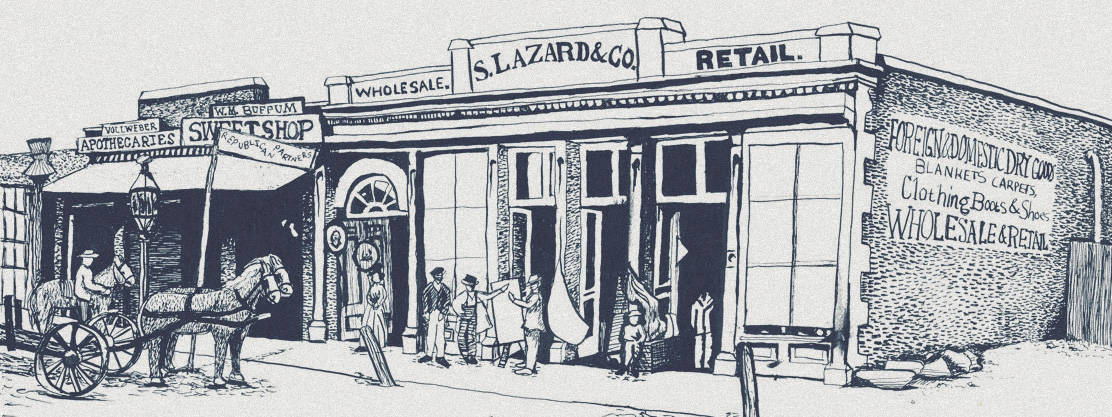
From our beginnings as a small New Orleans dry goods store to our role today as one of the world’s leading financial institutions, Lazard’s 175-year history is defined by evolution, resilience, and global perspective.
To mark our 175th anniversary, we created a retrospective film and commemorative digital book highlighting the people, milestones, and moments that have shaped our story.
Lazard Through the Years
Before Lazard was a bank, it was a family of merchants — and almost from the beginning, an international one. Within a generation, two brothers' arrival in New Orleans grew into stores and offices spanning New Orleans, San Francisco, New York, Paris and London.
1841
Alexandre and Lazare Lazard, two brothers from Frauenberg, France, arrive in New Orleans. They immediately set to work buying goods wholesale in the city and traversing the countryside selling items piecemeal to settlers and farmers. Within several years they achieve enough success to write home and invite a third brother, Simon, to join them.
1845
The three brothers open their first store on New Orleans' Frenchmen Street, a short walk from the city docks where the brothers could attend the daily unloading of cargo-laden clippers and steamships from around the world. The Lazard brothers specialize in "dry goods," a term for fabrics, clothing accessories, haberdashery, and related items.
1848
Alexandre, Lazare and Simon Lazard decide to give their partnership a legal framework, drawing up a contract that marks the founding of Lazard Frères & Co. They are soon joined by their two younger brothers, Elie and Maurice, as well as several cousins.
1851
When news spreads of spectacular gold discoveries in California, the Lazard brothers decide to seize the opportunity. Simon, Elie and Maurice move to San Francisco to open a new store to serve the booming local economy. Alexandre Lazard moves to New York City where he can oversee Lazard's supply chain. Lazare, the eldest brother, retires from the firm.
1854
Alexandre Lazard returns to France and opens a Lazard office in Paris, overseeing the export of fine French fashion to meet growing demand in San Francisco. He is followed by Simon.
1860s
Lazard Frères transitions out of retail and into banking. The company has a substantial clientele of French émigrés, and with gold the common currency, Lazard begins helping them ship the precious metal safely to their families in France. This evolves into the handling of commercial drafts and currency exchange. The growing business expands its lending services, even offering mortgage loans.
1870
Paris comes under siege in the Franco-Prussian War and Alexandre Lazard opens a temporary London office to ensure uninterrupted client service. Simon Lazard stays in Paris, despite dire wartime conditions.
Having wound down its dry goods business, Lazard chartered as a bank and rapidly built a global branch network, from London to San Francisco to New York, while establishing itself among the era's leading gold and currency exchange houses.
1876
After years of careful planning, Lazard liquidates the last of its dry goods inventory and becomes a chartered bank, establishing a head office in Paris and a branch in San Francisco.
1877
Lazard Frères opens a banking branch in the City of London at 60 Old Broad Street. The firm begins to establish correspondent offices around the world, including Asia.
1880
Lacking a presence on Wall Street, Alexandre Lazard leaves San Francisco, his home for 30 years, to open a branch in New York City. Arriving with almost no local relationships, Alexandre leverages the family's retail contacts to build a banking business with a small but quality clientele, discounting their bills and financing their growth.
1884
Lazard gradually becomes one of the United States' leading exporters of gold, and one of its leading currency exchange houses, helping the firm gain entry to the inner circles of New York's banking syndicates. In an era where steamships take weeks, if not months, to deliver the precious metal across the Atlantic Ocean — putting the firm's capital out of reach and at risk — Lazard needed additional capital to continue growing.
The firm's partners create the London, Paris and American Bank Ltd. (LOPA), raising funds primarily in San Francisco, where Lazard continues to have its biggest network of relationships. The bank operates with a London charter in order to take advantage of a lower cost of capital in Britain and the opportunity to leverage Britain's commercial ties to Asia.
1906
The San Francisco earthquake destroys the local Lazard office, but customer assets are preserved. The firm plays an active role in the city's rebirth. David Weill takes over Lazard Frères as senior partner following the death of his father, Alexandre Weill.
1914
With the coming of the First World War, Lazard's Paris office becomes short-staffed as its partners join the military, but it continues operations on behalf of the French government, assisting with financing needs for the war effort. Across the English Channel, Lazard's London office aids the British government in its own financing. With Europe subsumed by war, Lazard's U.S. banking operations continue to grow in size and stature.
The firm evolved into three 'Houses of Lazard' in the United States, France, and the United Kingdom, separately managed but allied. The Lazard partners advised clients on financial matters and enhanced their cross-border network of relationships in business and government. Through war and market upheaval, the separately managed Houses of Lazard weathered some of the most turbulent decades in modern financial history.
1919
Against the backdrop of nationalist sentiment in the U.K. after World War I, the Lazard partners seek to strengthen local ownership of Lazard Brothers, the London house. They sell a minority stake to Weetman Pearson, a wealthy industrialist and prominent client of the firm.
1924
Following World War I, France suffers from spiraling debt and a limping economy. International currency speculators began to sell the franc. By 1924, the franc's value is collapsing and France's economy is in jeopardy. A counter-offensive to save the franc is conceived by Frank Altschul, Director of Lazard New York. The strategy is to coordinate with the Banque de France, London's City banks, and the major U.S. banks to sell massive amounts of the world's major currencies while buying the franc. For 12 days in March, the "battle of the franc" rages. In the end, with the franc stabilized, the short sellers are routed and many prominent speculators are driven into bankruptcy.
1931
Fraud is discovered in Lazard Brothers' Brussels office. The financial impact is enormous and threatens to bankrupt Lazard's partners. The Bank of England helps arrange a loan from Weetman Pearson, which will bail out Lazard Brothers, and Pearson becomes 80% owner of the London house. His stake will eventually transfer to the family business that becomes Pearson plc.
1933
Following the Glass-Steagall Act, Lazard in the U.S. ceases commercial banking activity and becomes an investment bank. For the next 10 years, the U.S. house will expand its retail brokerage operations, following the model of most U.S. investment banks at the time.
1944
Pierre David-Weill, son of David Weill, becomes senior partner based in Paris; André Meyer becomes head of Lazard's U.S. operations. André Meyer shuts down the American retail brokerage operations.
In the postwar decades, seminal Lazard figures André Meyer, Michel David-Weill, and Felix Rohatyn built Lazard's reputation as a first call for corporate leaders and governments alike, while the firm's asset management business took root in London, Paris and New York.
1953
Lazard begins asset management operations in London.
1969
Lazard Paris begins an asset management business.
1970
Lazard Asset Management is established in New York and registered with the Securities Exchange Commission (SEC).
1975
Lazard Senior Partner Felix Rohatyn is approached by the Governor of New York State with a seemingly impossible task: to save New York City from imminent bankruptcy, as head of the newly formed Municipal Assistance Corporation (MAC). Against all odds, Felix oversees successful negotiations to rescue the city. He remains MAC Chairman for 20 years. All the while, he keeps his partnership at Lazard, where his advice is sought by leading corporate executives. Michel David-Weill, great-grandson of Alexandre Weill, is named Senior Partner of Lazard's Paris partnership.
Lazard navigated nationalization threats, restructured its ownership, and ultimately united its three historically separate Houses into a single global partnership before taking the firm public in 2005.
1984
A new entity is formed, Lazard Partners, with control of the three houses headquartered in London, Paris and New York. Pearson's longtime stake in the London house is replaced with a 50% stake in Lazard Partners.
1995
Lazard Frères Gestion is established in Paris, paving the way for ambitious growth in asset management and private banking in France.
1997
The U.K. and U.S. asset management activities are integrated, forming a single asset management entity to provide a more globally integrated perspective.
2000
Following the sale by Pearson of its Lazard holdings, the three Houses of Lazard are formally reunited as Lazard LLC.
2002
Bruce Wasserstein is named Head of Lazard LLC and begins a significant expansion of the firm's global office network.
2005
Lazard ends 157 years of private ownership and becomes a public firm with well-established offices around the world.
2008
The Global Financial Crisis begins. Lazard plays a vital role in shoring up and restructuring major financial institutions, including the winding down of Lehman Brothers, the largest bankruptcy in U.S. history.
Under new leadership, Lazard helped guide markets through the Global Financial Crisis's aftermath and the European sovereign debt crisis, expanded its advisory capabilities, and marked its 175th anniversary as one of the world's leading financial institutions.
2009
Kenneth M. Jacobs is named Chairman and CEO of Lazard, following the sudden passing of Bruce Wasserstein.
2012
Lazard's Sovereign Advisory team successfully negotiates an agreement to restructure Greek debt, heading off the potentially disastrous outcome of Greece falling out of the euro currency zone.
2013
Lazard launches a dedicated Shareholder Advisory group, building on its takeover-defense expertise to help public companies navigate the rising influence of activist shareholders.
2022
Lazard launches its Geopolitical Advisory group, bringing together some of the world's most experienced geopolitical minds, including former U.S. Navy Admiral William McRaven, former CIA Deputy Director of Intelligence Jami Miscik, and former U.S. Central Command Chief General John Abizaid, to advise clients on the intersection of geopolitics, policy, and business strategy.
2023
Lazard celebrates its 175th anniversary.
Peter R. Orszag is named CEO of Lazard with Ken Jacobs becoming Executive Chairman. Shortly following, the firm rolls out "Lazard 2030," a long-term growth strategy built on three objectives: deepening client relevance, to double firm-wide revenue and deliver average annual shareholder returns of 10–15% per year through 2030.
Lazard launches LazGPT, its generative AI platform, positioning the firm as an early adopter of among independent advisory firms.
Since rolling out its long-term growth strategy, Lazard 2030, the firm has evolved its leadership, expanded into new capabilities, and grown its global platform.
2024
Lazard completes its conversion to a U.S. C-Corporation, simplifying its structure and opening the opportunity to attract new shareholders.
Dan Schulman, former CEO of PayPal, and Steve Howe, former U.S. Chairman and Managing Partner of the Americas at EY, join Lazard’s Board of Directors, bringing public-company leadership and deep financial services, audit, and governance expertise.
Lazard and Elaia Partners form a strategic partnership, launching Lazard Elaia Capital, a technology-focused private equity investment platform in Europe.
Lazard rolls out Rogo, an AI analyst platform built for finance and co-founded by a former Lazard banker, showing how quickly the firm can pilot and adopt new tools as it works toward becoming the leading AI-enabled independent financial firm.
As part of a multi-year succession plan, the Board names Peter Orszag Chairman, effective January 2025, and appoints Dan Schulman Lead Independent Director, with Ken Jacobs transitioning to Senior Chairman and Senior Advisor to the Board.
2025
Peter Harrison, former CEO of Schroders, and Dmitry Shevelenko, Chief Business Officer of Perplexity, join Lazard's Board of Directors, bringing decades of investment-management leadership and cutting-edge technology perspective to the firm.
Lazard opens a new, larger UK headquarters at 20 Manchester Square in London, relocating from 50 Stratton Street after more than 20 years there.
Lazard Asset Management launches a suite of active ETFs in the U.S., surpassing $1 billion in AUM within a year, and Lazard names Chris Hogbin as incoming CEO of Asset Management.
Financial Advisory expands its global footprint, opening a new office in Denmark and broadening its Middle East presence with offices and teams in Riyadh and Abu Dhabi, while adding Managing Directors in key sectors.
The firm publishes an update to its vision and long-term growth strategy, "Lazard 2030: Beyond What the World Sees Today," reaffirming its objectives as measured by relevance, revenue, and returns, with a sharpened focus on AI and on helping clients see beyond what the world sees today—the insight and judgment the firm now calls contextual alpha.
2026
Tracy Farr is named Chief Financial Officer and Kathy Elsesser, a former Goldman Sachs partner, joins Lazard’s Board of Directors, adding deep financial services expertise to the firm’s leadership.
Lazard completes its acquisition of Campbell Lutyens, a premier global private markets advisor, and launches Lazard CL, the firm’s third global business alongside Financial Advisory and Asset Management, an important milestone on the path to Lazard 2030 that deepens the firm’s private capital connectivity for clients.